

Key Points
The list of stablecoins that have grown beyond a $1 billion market cap has been growing rapidly, pushing the combined market value of these assets beyond $300 billion recently.
Stablecoins revolutionized the financial industry, as they created a simple gateway to the crypto ecosystem that allows traders and investors to earn passive income and protect themselves from the market’s natural volatility momentarily.
However, these assets have evolved from mere “parking spots” for capital into sophisticated financial instruments. For the modern investor, holding a static stablecoin that sits idle in a wallet is no longer an option.
In this guide, we will analyze the list of stablecoins that are currently dominating the market. These are robust alternatives that offer high liquidity, attractive yields, and robust pegging mechanisms.
Top Trends in 2026: Zero-Yield Stablecoins are No Longer Acceptable in Crypto
Before we dive into our list of stablecoins, it is worth noting that we have identified some interesting trends in this market lately. There seems to be an ongoing convergence between Traditional Finance (TradFi) and Decentralized Finance (DeFi).
In response to a growing appetite for yield, top DeFi protocols and centralized exchanges have launched new platforms through which users can earn attractive yields on their stablecoins.
In 2026, the “risk-free rate” in crypto is no longer zero; it is effectively anchored to tokenized U.S. Treasury yields and delta-hedged funding rates.
This means that even the most conservative stablecoins are now expected to outpace traditional high-yield savings accounts, which typically offer around 4% to 5% in the current economic cycle.
1. Tether (USDT): The Liquidity King
Tether remains the largest and most liquid stablecoin in the crypto ecosystem, with a market cap exceeding $180 billion.
Despite the appearance of new heavily regulated competitors, USDT’s footprint across every major blockchain, from Ethereum and Tron to high-speed networks like Solana, has made it the undisputable market leader with a 60% share.
What is USDT: A fiat-collateralized stablecoin backed by cash, U.S. Treasuries, and other assets, including Bitcoin (BTC) and gold.
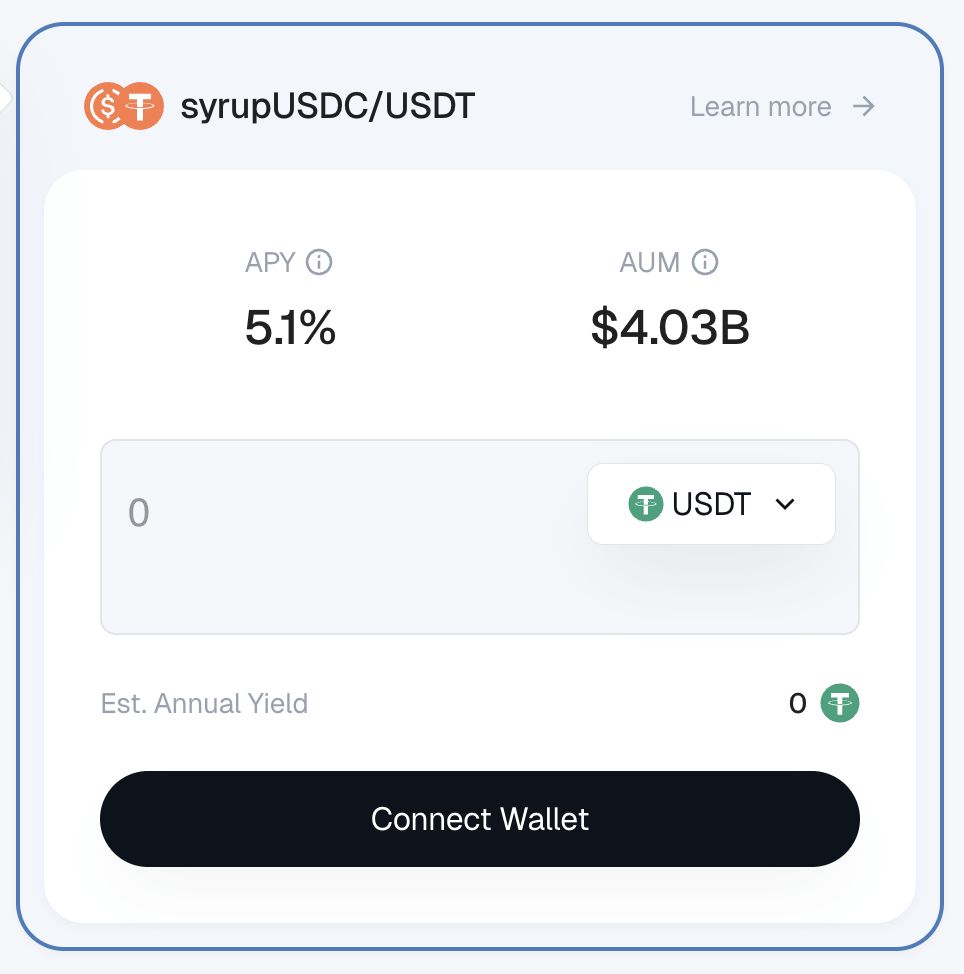
Yield Mechanism: Because USDT is so widely used, its primary way to produce yield is through lending platforms. Traders can borrow USDT to leverage their positions, driving up interest rates on lending platforms.
Top Protocols
- Aave V3: A decentralized lending platform that offers some of the most stable lending rates on the Ethereum ecosystem.
- JustLend: The dominant choice for those holding USDT on the Tron network. The protocol invests in real-world assets (RWAs) individually vetted by the JustLend DAO.
- Maple Finance: Its smart vaults invest USDT in institutional loans and liquidity pools.
- Binance Earn: The largest CEX in the world commonly offers attractive stablecoin yields exceeding 5% via its Flexible Earn product.
Analyst’s Note: USDT is best for investors who prioritize instant liquidity. Because it fuels over 60% of all trading volume, you can exit a position and swap your asset in seconds with virtually zero slippage.
2. USD Coin (USDC): The Institutional Alternative
If USDT is the stablecoin for crypto-natives, USDC is the preferred vehicle for institutions and regulated fintechs.
Issued by Circle, USDC has spent the past two years solidifying its role as the “most compliant” instrument used by Wall Street heavyweights to interact with the crypto market.
What is USDC: A U.S.-regulated stablecoin backed 1:1 by cash and short-term U.S. Treasuries.
Yield Mechanism: USDC yields are increasingly driven by real-world assets (RWA). Many protocols now wrap USDC to invest directly in tokenized Treasury bills, passing that yield back to users.
Top Protocols
- Morpho Blue: Known for its highly efficient, isolated lending vaults. This protocol offers high APYs often exceeding 10%.
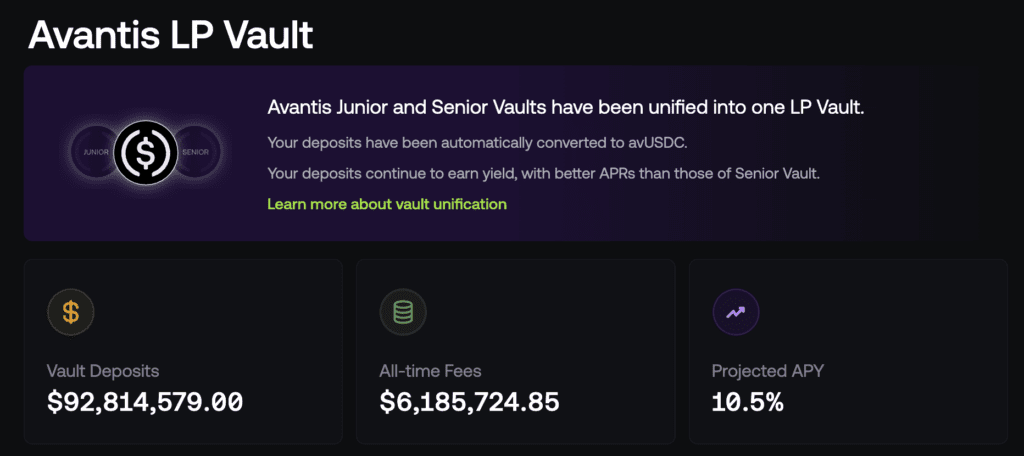
- Avantis: The largest decentralized exchange (DEX) on Base distributes trading fees and losses to a smart vault that USDC holders can access to earn yield on this stablecoin. It offers attractive yields above 10% usually.
- Coinbase Earn: A centralized “set-and-forget” option for retail users, often offering yields ranging from 3.5% to 5%.
3. RLUSD (Ripple USD): The “Compliant” Newcomer
Launched by Ripple in December 2024, RLUSD is the network’s first native stable asset, designed specifically to facilitate cross-border payments and institutional settlement.
Its arrival has introduced a new layer of trust for conservative investors who were previously hesitant to enter the DeFi space.
What is RLUSD: A 1:1 USD-pegged stablecoin issued under a New York Trust Company Charter, ensuring robust regulatory oversight.
Yield Mechanism: RLUSD is primarily used to support on and off-ramp platforms that power the growing XRPL ecosystem. Users can earn “market-making” fees by providing liquidity on decentralized exchanges (DEXs) that facilitate global remittances. In addition, some Ethereum protocols are also offering attractive yields on this stablecoin.
Top Protocols
- Euler Finance: A premier lending protocol where RLUSD is gaining significant traction. Its smart vaults currently offer yields exceeding 6%.
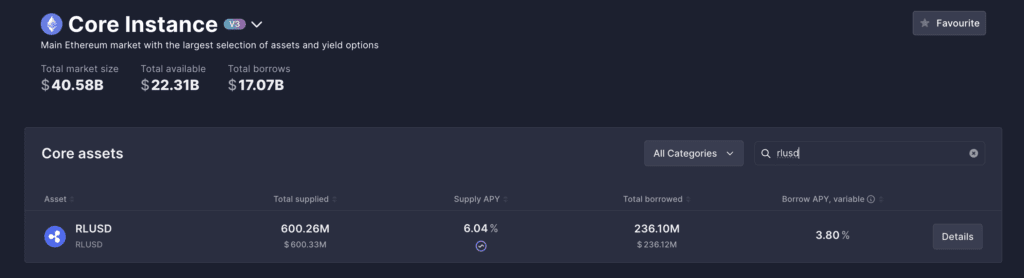
- Aave: Ethereum’s top lending protocol currently offers stablecoin yields exceeding 6%, including incentives from programs like Merkl.
- XRPL AMMs: The native Automated Market Makers on the XRP Ledger.
4. USDS (Sky Dollar): The Decentralized Alternative
Formerly known as DAI, MakerDAO rebranded both its DeFi protocol and its flagship stablecoin to Sky (USDS).
This asset represents the pinnacle of decentralized governance, backed by a diversified basket of over-collateralized crypto assets and RWAs.
What is USDS: A decentralized, over-collateralized stablecoin governed by the Sky Ecosystem.
Yield Mechanism: The “Sky Savings Rate” (SSR) allows users to earn a native yield directly through the protocol by locking up their USDS.
Top Protocols
- Sky Protocol (formerly Maker): The primary source for the native savings rate.
- Aave: yields for USDS on this Ethereum-based lending platform currently stand at around 5%.
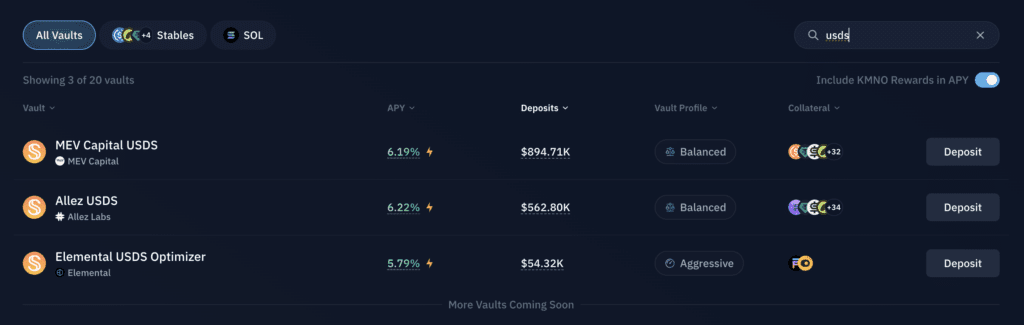
- Kamino: A Solana-based lending protocol that offers a handful of USDS vaults with APYs exceeding 6%.
5. USDe (Ethena): The Algorithmic Disruptor
USDe is the most technically unique asset on our list of stablecoins. It is not backed by bank deposits, physical dollars, or cryptos.
Instead, it is a “synthetic dollar” that maintains its peg through a sophisticated delta-neutral hedging strategy that collects Ethereum (ETH) funding rates.
What it is: A synthetic dollar created by Ethena Labs that uses Ethereum (and Bitcoin) as collateral while simultaneously opening short positions using derivatives like perpetual futures to “neutralize” price volatility.
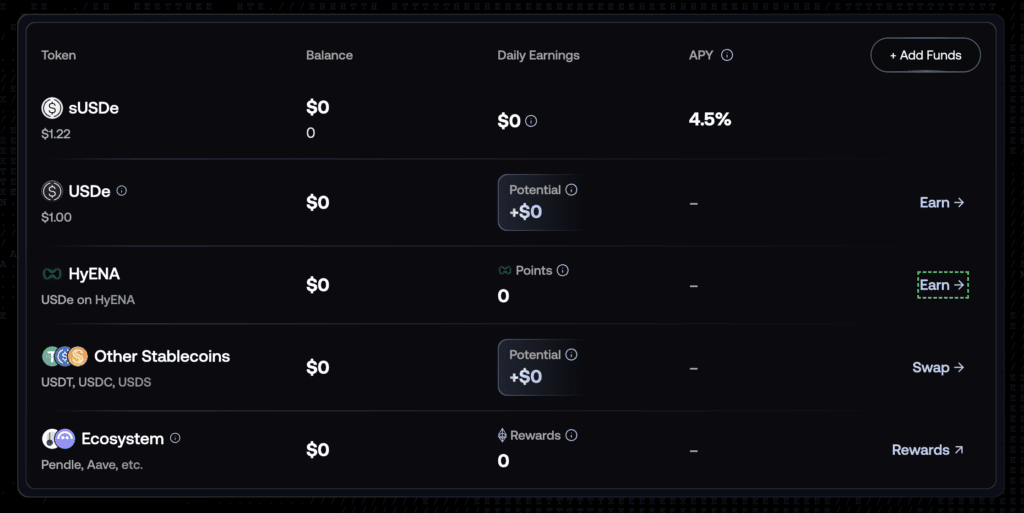
Yield Mechanism: This is the highest-yielding asset on this list of stablecoins. It offers two streams of income: the staking rewards from the collateral it holds (e.g., staked ETH) and the funding payments earned by its short positions.
Top Protocols
- Ethena Labs (sUSDe): Users can stake USDe directly on Ethena’s DeFi platform to receive sUSDe, earning an APY ranging between 5% and 13% depending on market conditions.
- Pendle Finance: Suitable for advanced users seeking to identify and constantly re-allocate their USDe to the highest-yielding liquidity pools and vaults.
Risk Management: Tips to Earn Passive Income on Stablecoins Safely
While the prospect of earning 15% on a dollar-pegged asset is enticing, a decade of experience in the markets has taught me that yield is never free.
Every percentage point above the “risk-free” rate represents a specific type of risk:
| Risk | Description |
|---|---|
| Smart Contract Risk | The protocol you are using could have unidentified weaknesses that hackers could exploit to drain funds. |
| Depeg Risk | The stablecoin could lose its target $1.00 value. Prominent incidents include Terra’s collapsed UST algorithmic stablecoin back in 2022. |
| Liquidity Risk | In a market crash, you might not be able to withdraw your funds immediately. |
A robust “treasury” strategy diversifies funds across different exchanges and vaults to mitigate some of these risks.
Conduct proper due diligence on any stablecoin you use and each protocol. For stable assets, ensure that they are transparent about their reserves and clear about how they plan to maintain their peg.
For protocols offering yields, analyze how they produce the income and stay away from “incentive-heavy” offerings that aim to lure capital to temporarily boost the vault’s assets.
Final Thoughts
This list of stablecoins offering attractive yields in 2026 has something for every type of investor.
If you prefer to stay away from big risks, the RWA-backed yields offered by USDC or the regulated nature of RLUSD are probably your best bets.
However, if you understand the mechanics of funding rates and want to maximize your passive income, USDe provides a crypto-native alternative that the community has rapidly embraced.
As always, diversification is key. Never park your entire portfolio in a single protocol or a single stablecoin. Spread your capital across different vaults and platforms to ensure that even if one pillar falters, your house will still be standing.