
Key Points
Funding rates are one of those metrics that rarely make it to the headlines, yet they are a powerful tool that indicates how the market is positioned and what the current bias is – bullish or bearish.
Leverage plays a central role in crypto trading. Hence, understanding what rising funding rates indicate can provide valuable context on where risk is building — and where volatility may soon follow.
What Are Funding Rates and Why Do They Matter?
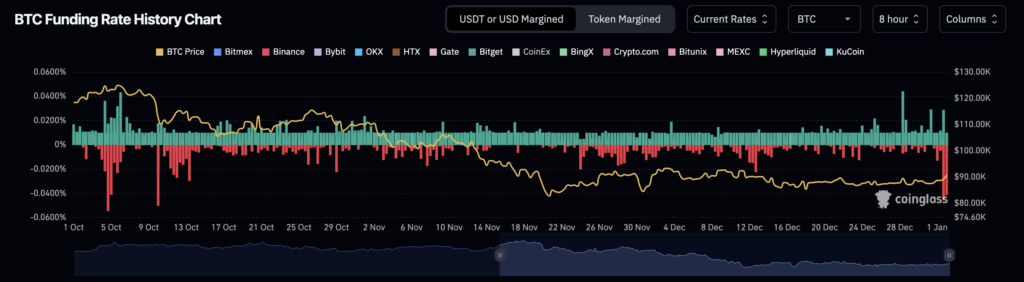
Funding rates are used to make periodical payments to traders in the perpetual futures markets. Their purpose is simple: keep the price of perpetual contracts anchored to the underlying spot price.
When funding rates are positive, long positions pay short ones. This typically means that bulls are in control of the market, as traders are willing to pay a premium to keep their long positions open. Conversely, negative funding rates indicate bearish sentiment, as short positions pay long ones.
Unlike spot volume or price trends, funding rates reveal how crowded a trade has become. Elevated rates suggest that leverage is skewed heavily in one direction — a situation that often leaves the market vulnerable to sharp reversals.
Why Rising Funding Rates Often Precede Volatility Spikes
Persistently rising funding rates are rarely sustainable. As the cost of holding leveraged long positions increases, traders become more sensitive to even minor price pullbacks. This creates a fragile environment where small downward moves can cascade into forced liquidations.
In practical terms, high funding rates signal that optimism may be getting out of hand. If the price continues to move higher, the move could accelerate and squeeze bears out. However, if momentum stalls, the same leverage that fueled the rally can quickly unwind, amplifying volatility to the downside.
This dynamic explains why periods of elevated funding rates often coincide with expanded price ranges rather than steady trends. The market becomes reactive, with sharp swings driven less by fundamentals and more by positioning imbalances.
When Funding Rates Increase… This Happens
Historically, extreme funding rates have tended to appear near inflection points. During strong bull phases, funding has remained positive for extended periods, but spikes have frequently preceded local tops and abrupt corrections. Conversely, deeply negative funding has often emerged near market bottoms, reflecting excessive pessimism before relief rallies.

These patterns do not imply that rising funding rates automatically signal an imminent crash. Instead, they highlight a shift in risk distribution. When leverage concentrates too heavily on one side of the market, crypto prices become more sensitive to external catalysts — whether those are macroeconomic data points, regulatory headlines, or sudden changes in liquidity conditions.
What Traders Should Keep An Eye On?
Rising funding rates are best interpreted alongside other indicators. Open interest trends, spot volume, and liquidation data help determine whether leverage is expanding alongside genuine demand or if it is the result of speculative activity.
In the current market environment, elevated funding rates suggest that bullish conviction is strong — but it could also be getting increasingly expensive. Whether this leads to continuation or correction will depend less on sentiment alone and more on how prices react when pressure finally tests that positioning.